Thirty years on the men's floor at a department store in St. Louis taught me one thing: suit jacket sleeve length is the first thing I check when a man walks in wearing a jacket. It's also the thing most men never think about until they see a photo of themselves at a wedding. By then, it's too late for a quick fix.
I've handed dress shirts to tens of thousands of men, and I'd bet a third of the jackets that came back were returned not because the shoulders were wrong, but because the sleeves didn't look right. Men would stand in front of the triple mirror, turn sideways, and just know something was off. They couldn't name it. I could see it from the counter.
The Rule I Used on the Men's Floor
The rule is simple. A suit jacket sleeve should end right at the wrist bone, where your hand meets your arm. When you stand with your arms relaxed at your sides, you should see about a quarter to a half inch of your dress shirt cuff peeking out below the jacket. If you see a lot of shirt, the sleeves are too short. If you see no shirt at all, they're too long.
Sounds easy, but the fitting room tells a different story. Men come in wearing jackets that are a full inch too long because their father wore them that way. Or they buy short sleeves because a salesperson told them "modern fit" meant everything shrinks up. Let me clear the air.

The suit jacket sleeve length is not a style choice. It's a proportion. It connects the jacket to the shirt to your hands. When the jacket sleeves are too long, the shirt cuff disappears and the jacket swallows your hands. You look like you borrowed the coat from an older brother. When they're too short, you look like you're about to wash dishes.
The half inch rule is a starting point. If you're a bigger guy or you have long arms relative to your torso, that quarter to half inch of cuff is still the target. The shirt is the frame. The jacket is the mat. The cuff is the picture. You don't want the mat covering the picture.
After a full day of wear, jackets ride up a bit. If you start with a half inch of cuff, you'll end with a quarter inch by dinner. If you start with no cuff at all, by the time you sit down, eat, and shake hands, the shirt disappears completely. So you want a little extra at the start.
How to Check Suit Jacket Sleeve Length Yourself
The easiest way to check your current suit jacket sleeve length is to stand in front of a mirror with your arms down at your sides. Relax. Don't flex. Look at the back of your hand. The jacket should just brush the top of your wrist. Raise your arm to a 90-degree angle. The sleeve should slide up your forearm and expose more shirt. That movement is normal. If the sleeve is so tight it doesn't slide, that's a different problem with the armhole, not the length.
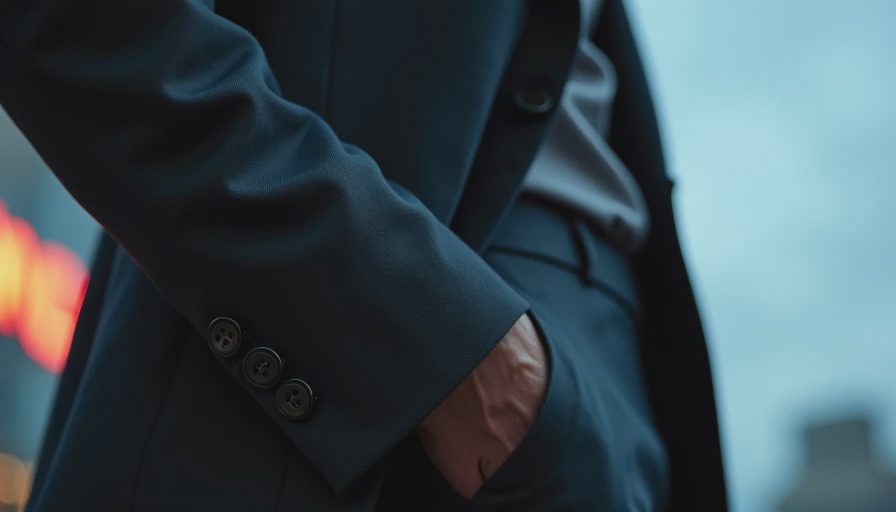
Here's what I tell every man who asks about shortening. Take the jacket to a tailor or a dry cleaner that does alterations. Shortening sleeves is one of the most common alterations on the floor, and most tailors charge between fifteen and twenty-five dollars per sleeve. Some charge more if there are functional buttons. The money is worth it. A jacket that fits in the shoulders but has off sleeve length is a candidate for the needle. One that has the right sleeve length but is too wide in the chest is a different story — you can't tailor a jacket that's structurally wrong without spending a lot.
What a Tailor Charges and Why It's Worth It
At my store, a man would bring in a jacket and point at the sleeves. "Can you fix this?" I'd tell him to take it to Manny's alterations down the street. Manny could do it in two days. It cost twenty dollars. The man would come back, try it on, and stare at his wrists like he'd discovered something.
The biggest mistake I see isn't the length. It's the number of buttons on the cuff. If your jacket has four buttons, you don't need to shorten the sleeves by opening the bottom button. A tailor knows to shorten from the shoulder seam, not the cuff, when the buttons are functional. If a tailor says "I'll just take it from the cuff," find another tailor. Shortening from the shoulder keeps the button spacing and the shape of the sleeve intact. It's a little more work, so some shops avoid it. But it's the right way.
When Not to Overthink It
Now, when do you leave the sleeves alone? When the jacket is a blazer or a sport coat you wear casually with jeans, you can get away with a little more length. The same half-inch rule still applies, but a relaxed jacket can show less cuff. Even then, if the sleeve covers your entire wrist bone, it's too long.
One more thing: don't buy a jacket expecting to let the sleeves out. There's only so much fabric inside the hem. Most jackets can be let out about a half inch before the stitch marks show. If you're between sizes and the sleeves are a half inch too short, it might work. Any more than that, and the sleeve won't hang right.
The Bottom Line
The bottom line from thirty years on the floor: suit jacket sleeve length is the cheapest, fastest way to make a $200 suit look like it cost $500. Check it in the mirror. Take it to a good tailor. Try it on before you leave the shop. That's what the fitting room is for.




No comments yet — grab the first one.